It's Not What You Know, It's Who You Know.
Sophee Sanderson @socialsophee
Have you ever been scrolling on social media and stumbled across a post and thought to yourself, "Who are these people?"
Well, you're not alone. That's usually what is going through my head every time I open Facebook or Instagram and it has led me to purge a lot of people from my online network.
In chapter ten of "Understanding Digital Literacies," Rodney Jones and Christoph Hafner go into detail about the ins and outs of social networking and the meaning behind 'friends' on sites like Facebook.
They discuss how there are many different ideas behind the meaning of a friend online. Some argue that online connections are strengthening friendships while others disagree and say friendships are becoming devalued and less meaningful.
A friend online can represent a connection with someone who you are actually friends with or it could be someone who is a total stranger. Most people's social networks consist of close friends, relatives, mutual friends, acquaintances and so on. Our online social networks are a mix of strong and weak ties. These ties range from people who have seen us completely naked to people who wouldn't even acknowledge our existence if we saw them in person.
However, weak ties are not necessarily considered a bad thing. Some weak ties can simply be a connection to something greater. For instance, you might be "friends" with someone on Facebook who you drunkenly met at a New Years Eve party years ago, but they could also be your ticket to connecting you with the CEO of that big company you have always dreamed of working for. This kind of connection is known as a strong weak tie.
Strong and weak ties have always been a part of human connections, social networking has just made these ties more visible and clear-cut to us. In fact, the array of these connections is what builds our social network.
I seldom look at my Instagram feed, but in the rare times I do, I often come across pictures of people whose names I may recognize, but faces I can't picture-- and vice versa. I realized that it was actually kind of weird that I was allowing all these people to see my life, when we really didn't know each other.
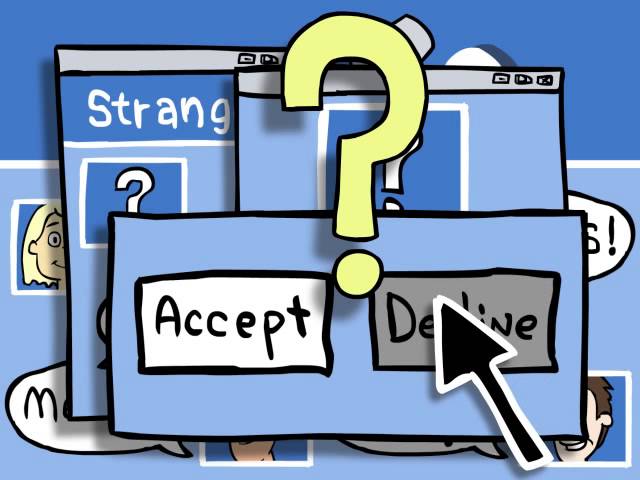 For example, when I first joined my sorority, hundreds of girls I didn't know started following me on Instagram. I eventually formed friendships and small connections with most of them, but there was still a large chunk of girls that I straight up did not know. If this happened to me now, I would probably decline or avoid responding to these requests until I knew the person better, but five years ago I was allowing almost everyone to join my social network. There have been many times where my online connections with these girls I hardly knew worked in my favor. A lot of them have helped me with school, career advice and more. Although these strong weak ties benefited me in the past, I don't really care to see their cousin's baptism or their cat's new outfit.
Understanding how to manage your social network connections means understanding the nature of those connections. Are they strong ties, weak ties or strong weak ties? Could they play an important role in your network on and off line? One's network and personal contacts are often more useful and critical for success than knowledge and skills.
Two more important functions that people in social networks conform to are connectors and mavens.
"Connectors are people who act as bridges, facilitating the flow of information, goods and services between different groups or clusters of people."
"Mavens are people in possession of or with access to things that are beneficial to other people, such as goods, services, knowledge, information as well as emotional commodities like friendship, loyalty and a sense of humor."
I recently did an unfollowing spree on my social media networks. I made the decision to unfriend someone and remove them from following me if I knew we would not speak to each other in public or if I simply just had no idea who they were. However, part of understanding my social network was acknowledging the people who I knew had potential to be a connector or maven.
I strongly encourage you to go through your friends list and pay attention to what kind of relationship you hold with your followers. Is your social network filled with people you don't know? Next time you're scrolling through Facebook or Instagram, think about if the people whose lives you are consuming could be a connector or maven in your network.
Perhaps an unfollowing spree could help you to eliminate all the people you don't really have a connection with. I know it has definitely made my feed more sensible, but before you click unfollow, just remember: it's not what you know, it's who you know.
References
Brown, E. (2011, June 30). Strong and Weak Ties: Why Your Weak Ties Matter. Social Media Today. Retrieved September 28, 2022, from https://www.socialmediatoday.com/content/strong-and-weak-ties-why-your-weak-ties-matter
Gilkey, C. (2012, April 4). How to Determine Your Archetype. Productive Flourishing. Retrieved September 28, 2022, from https://www.productiveflourishing.com/maven-connector-or-salesperson-whats-your-archetype/
Jones, R. H., & Hafner, C. A. (2021). Understanding Digital Literacies: A Practical Introduction. Routledge.
Neuman, F. (2014, June 11). "It's Not What You Know. It's Who You Know". Psychology Today. Retrieved September 28, 2022, from https://www.psychologytoday.com/us/blog/fighting-fear/201406/its-not-what-you-know-its-who-you-know
Ridgers, L. (2020, June 30). 7 Reasons Why You Should Have an Unfollow Spree on Instagram Today. Medium. Retrieved September 28, 2022, from https://medium.com/swlh/7-reasons-why-you-should-have-an-unfollow-spree-on-instagram-today-6aaa264e8cea

Comments
Post a Comment